.png)
Last Updated: September 27, 2026
Prescription discount programs are membership or card-based services that negotiate lower prices with pharmacies on medications you buy out-of-pocket. Unlike insurance, they don't cover a percentage of your cost, they reduce the actual retail price you pay at the counter. You present the card, the pharmacy looks up the negotiated rate, and you pay that lower amount directly.
Unlike Medicare Part D or traditional insurance, prescription discount programs have no deductible, monthly premium, or waiting period. Many use them alongside insurance when the discount beats their copay, or as a primary option when uninsured or when insurance doesn't cover a medication.
SafeWell55 members get access to prescription savings as part of their comprehensive wellness program, reducing out-of-pocket costs on regular medications.
Discount card companies negotiate rates with pharmacy networks. When you present your card, you access pre-negotiated rates instead of standard retail prices.
Negotiated rates through discount programs can offer significant savings compared to retail prices for common medications.
Negotiated rates vary by program and pharmacy, so comparing prices before filling a prescription is essential.
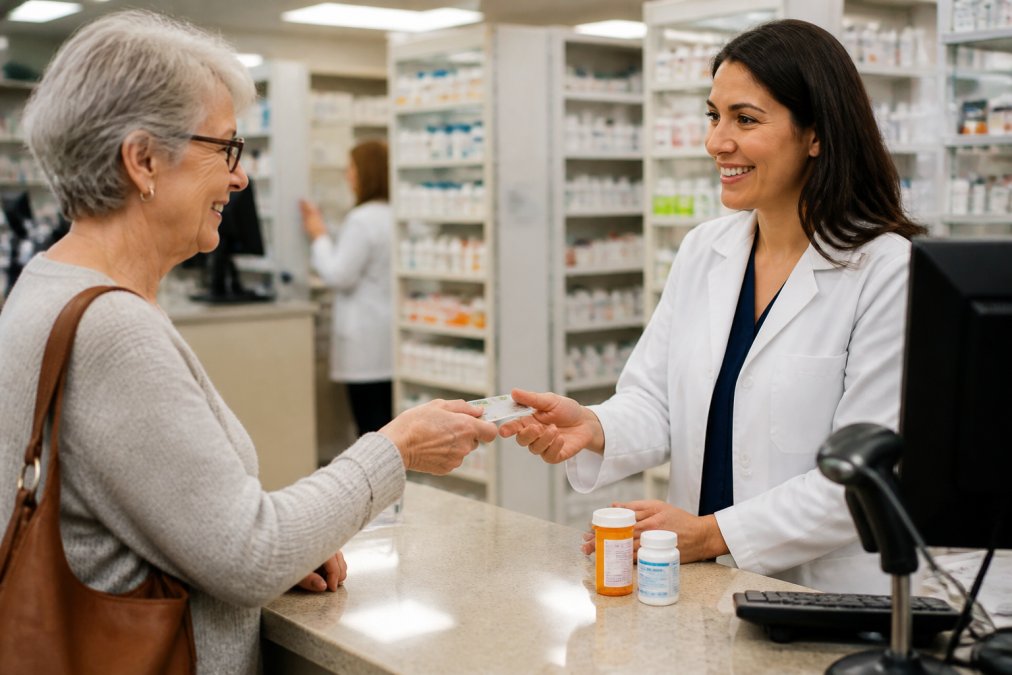
Discount programs work through networks of participating pharmacies, which vary in size and scope.
Before signing up, verify your preferred pharmacy participates in the program's network, as out-of-network pharmacies won't offer the discount.
To use a discount card, take your prescription to a participating pharmacy and tell the pharmacist you want to use your card. They'll enter the number and show the discounted price.
You pay out-of-pocket immediately with no insurance claim or waiting. Some pharmacies let you look up prices online beforehand.
Always ask the pharmacist to compare your insurance copay with the discount card price, this 30-second check often saves money on every fill.
If you have multiple plans or cards, ask the pharmacist to check all options.
If a pharmacist says they can't accept your card, here are the most common reasons:
Reason 1: The pharmacy isn't in the network. Verify participation on the program's website or by calling the number on your card.
Reason 2: The card has expired or isn't activated. Renew expired cards online (usually free and instant), or wait 24 hours for new cards to activate.
Reason 3: The pharmacy's system isn't recognizing the card. Ask the pharmacist to manually enter the number or call the program's support line (on the back of your card).
Reason 4: The prescription is controlled or restricted. Some programs exclude controlled substances or restricted medications. Ask about alternatives or generic options.
If the quoted price is higher than expected, here are common reasons:
Reason 1: The online price was for a different quantity or pharmacy. Verify the quantity (30-day vs. 90-day) and location, as prices vary.
Reason 2: The medication is out of stock or a different formulation was substituted. Confirm the dispensed medication matches your prescription.
Reason 3: The discount program's negotiated rate changed. Ask the pharmacist to show the current rate on their system.
Reason 4: You're not actually using the discount card. Ask the pharmacist to confirm the card was applied and re-quote if needed.
If unresolved, contact the program's customer service line (on your card). They can verify network status, card activation, correct pricing, and escalate system errors. Most offer phone, chat, or email support.
If you're on Medicare, you have Part D coverage. The key is understanding when each option makes sense for your specific medications.
Medicare Part D has an annual deductible and costs vary by medication tier and coverage phase: initial coverage, coverage gap, and catastrophic coverage. Costs can rise significantly in the coverage gap.
Prescription discount programs have no deductible or annual phases, offering consistent pricing regardless of annual spending, especially valuable during Part D's coverage gap.
Compare costs for your specific medications before each fill:
Step 1: Know your Part D phase. Early in the year you're in initial coverage. After spending a certain amount, you enter the coverage gap (which can have higher costs). Once you've spent enough out-of-pocket, you reach catastrophic coverage.
Step 2: Ask your pharmacist to compare. Request both your Part D copay and discount card price, most systems show both instantly and can save $10-$50+ per prescription.
Step 3: Use the cheaper option each time. Since Part D costs change throughout the year, re-check periodically, especially during the coverage gap.
Scenario 1: Common generic medication (e.g., lisinopril for blood pressure) Part D copay: Varies per month Discount card price: Varies for a 30-day supply Winner: Depends on the specific medication and your Part D phase
Scenario 2: Brand-name medication not yet on Part D formulary or on a high tier Part D copay: Varies per month Discount card price: Can offer savings off retail Winner: Depends on the specific medication and your Part D phase
Scenario 3: Specialty medication (e.g., biologics, injectables) Part D copay: Varies per month depending on tier Discount card price: May not be available or may offer savings Winner: Depends on the specific medication and your Part D phase
Medicare beneficiaries often assume Part D is always the right choice because it's "insurance." In reality, discount cards can offer significant savings annually for people willing to compare prices. The reverse is also true: some seniors pay out-of-pocket for discount cards when Part D would have been cheaper. The key is not loyalty to one system, but flexibility to use whichever is cheaper for each prescription.
SafeWell55 members have access to both their Medicare Part D coverage and additional prescription savings through the platform. This flexibility means you can optimize each prescription based on actual costs rather than being locked into one option.
Generic medications are chemically identical to brand-name drugs but cost significantly less (the FDA). If your doctor prescribes a brand-name medication, ask whether a generic version exists. Most medications have generic equivalents once the patent expires.
Pharmacists can often substitute a generic without needing a new prescription from your doctor. The pharmacy will verify that your doctor allows generic substitution, most do by default. Switching to generic when available is one of the fastest ways to reduce medication costs.
Discount programs often show even deeper savings on generics than on brand-name medications. The negotiated rates for commonly used generics can be remarkably low. Combine a discount card with generic options, and your out-of-pocket medication costs drop substantially.
A practical tip: don't assume all pharmacies have the same generic prices. Prices vary between chains and independent pharmacies. If you have flexibility in where you fill prescriptions, compare prices at two or three nearby locations.
Most prescription discount programs have no age restrictions and no income limits. If you're over 55 and looking for ways to reduce medication costs, a discount card is available to you regardless of income or health status. There's no application process beyond signing up.
When you use a prescription discount card, the pharmacy and the discount program have access to your prescription information. This raises legitimate privacy concerns. Understanding what happens with that data matters.
| Comparison Factor | Medicare Part D | Prescription Discount Programs |
|---|---|---|
| Annual Deductible | Yes, varies by plan | None |
| Monthly Premium | Yes, varies by plan | None or low flat fee |
| Coverage Phases | Yes, changes throughout year | No, consistent pricing |
| Eligibility | Age 65+ or specific conditions | Any age, any income |
| Generic vs. Brand | Varies by formulary tier | Often deeper discounts on generics |
| Best For | Comprehensive medication coverage | Specific medications, out-of-pocket savings |
Frequently Asked Questions
Do prescription discount programs work at all pharmacies?
Are there income limits or age requirements?
Yes, you can use a prescription discount card alongside Medicare, including Medicare Part D coverage. Some seniors use discount cards as a backup when Part D copays are high, or for medications not covered by their plan. Compare the out-of-pocket cost under your Part D plan versus the discount card price at the pharmacy counter before deciding which to use for each prescription. Not all pharmacies accept both simultaneously, so ask your pharmacist which option saves you more money for your specific medication.
Most prescription discount programs have no income limits, age restrictions, or insurance requirements. You typically need to enroll (often free or for a small fee) and provide basic information. Some programs require a valid ID at the pharmacy. Unlike prescription assistance programs that help low-income patients, discount cards are generally open to anyone. Check the specific program's website to confirm eligibility, as requirements vary by provider.
Insurance copays are fixed amounts you pay when covered by a health plan; the insurer negotiates the rest. Discount cards offer a percentage off the pharmacy's retail price, with no insurance involved. You pay the discounted price directly. Discount cards work for uninsured people and can sometimes offer better savings than insurance copays on specific medications. However, insurance may cover more services and protect you from very high costs, whereas discount cards have no annual limits or catastrophic coverage.
Legitimate prescription discount programs are real and widely used by pharmacies. They work by negotiating lower rates with drugmakers and pharmacies. However, some programs charge enrollment fees or promise savings that don't materialize. Research the program's reputation, check reviews, and verify that your local pharmacy accepts the card before enrolling. Avoid programs that make unrealistic claims or ask for excessive personal information.